


After centuries of persecution, wolves have now re-established populations in ten states: Michigan, Minnesota, Wisconsin, Wyoming, Idaho, Montana, Oregon, Washington, California and Colorado. This is one of the ESA’s greatest successes, especially when you note that as recently as 1973 wolves had been shot, poisoned, and trapped until there were fewer than 500 left in the lower 48 states (mostly restricted to just the remote northern forests of Minnesota). Now, there are roughly 8,000 wolves spread among ten states, and they have been delisted in Idaho, Montana, and Wyoming where their management falls to state wildlife agencies.
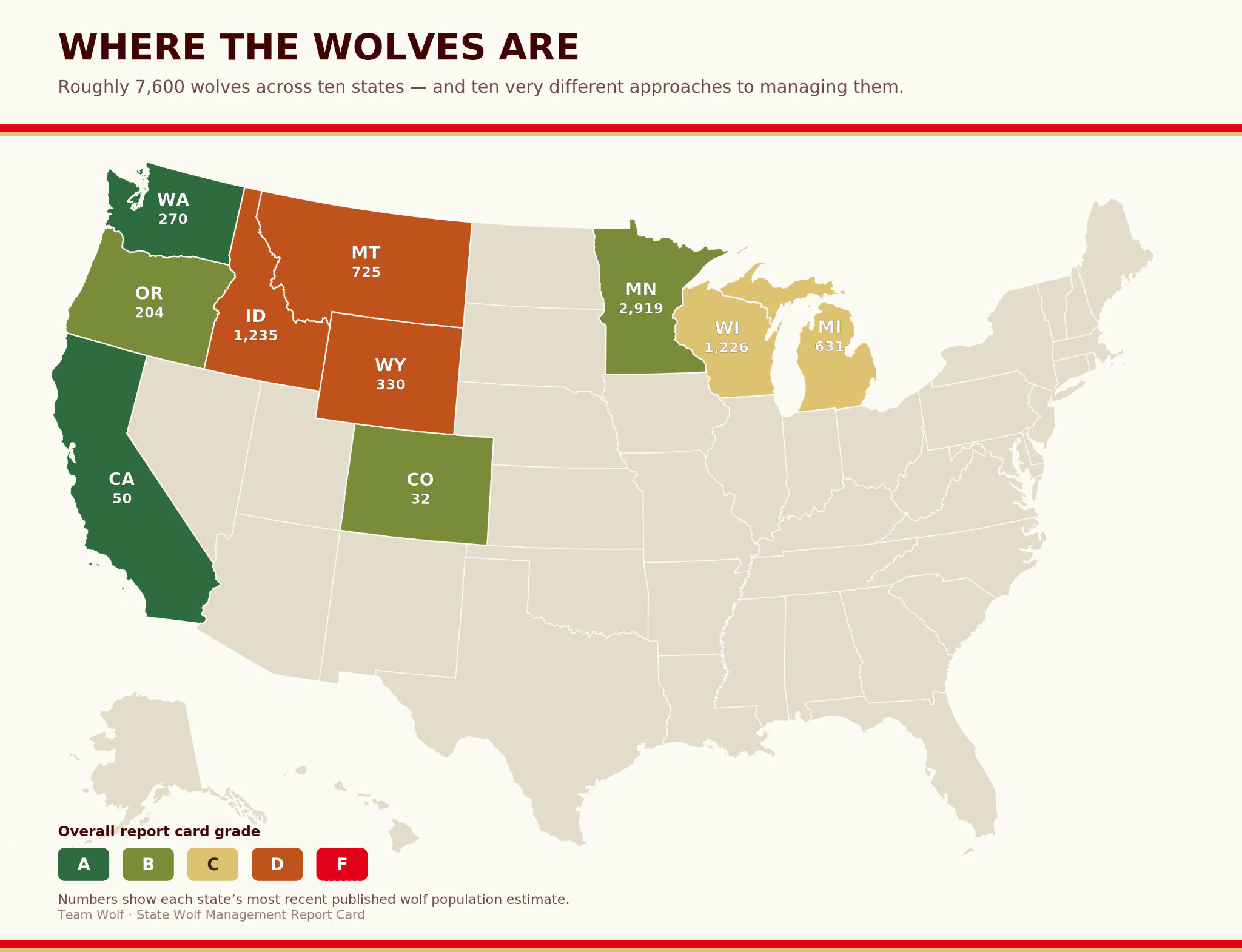
Roughly 8,000 wolves across ten states — and ten very different approaches to managing them.
Normally delisting would be a cause of celebration because it should reflect an escape from the extinction vortex, signaling successful recovery. For wolves it is not so simple. Once delisted, wolves become the responsibility of state wildlife departments, and several states have adopted wolf management plans that lack transparency, are weak on science, sanction lethal and inhumane methods, and are captive to special interests. For example, 2,380 wolf hunting permits were issued within a few weeks of when wolves were first delisted in Wisconsin. Without justification or any scientific analysis, a quota of 200 wolf kills was established. Wolf hunting season began Monday morning February 22 and by 3PM Wednesday (February 24th) the season had to be closed because the quota had been exceeded with 218 wolves killed in 60 hours. Killing a fifth of Wisconsin’s wolf population within a month of being delisted from the ESA should strike everyone as foolhardy. Yet, that is exactly what happened in February of 2021, when ESA protection was removed and wolf management was turned over to the state. It does not have to be this way — there are also several “good actor” states that are exemplary models in the science, transparency and humanity of their wolf management plans.
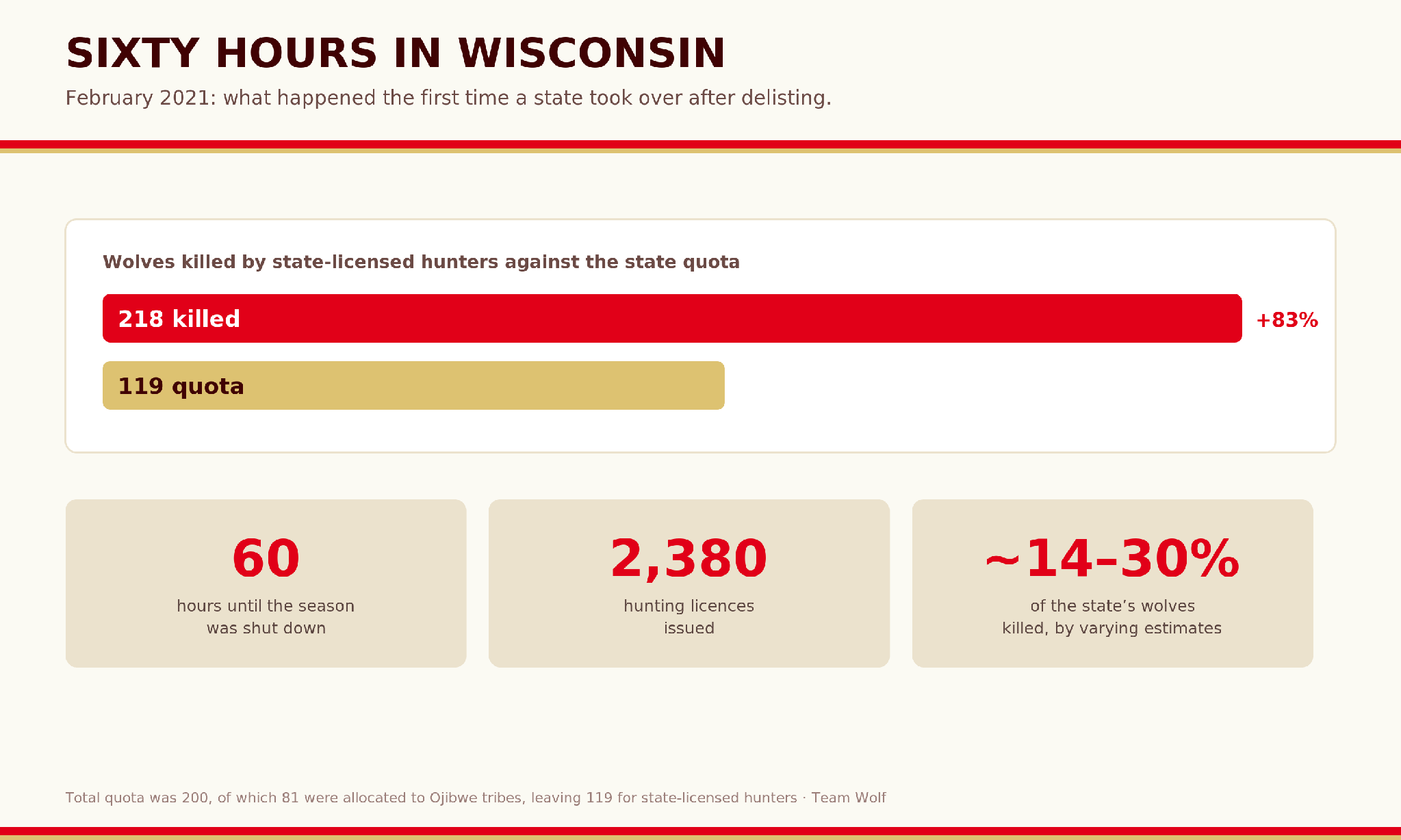
February 2021: what happened the first time a state took over after delisting.
Looking to the future, as wolf populations grow and spread to new states, they will eventually be delisted in many regions of the US. If we could count on the states doing a good job, delisting would be something to celebrate. But what do we mean by a “good job”, and how might we evaluate a state’s performance?
To hold states accountable as they take over wolf management, Team Wolf has designed a Wolf Management Report Card. A “good” management approach to wolf control should be scientifically sound, transparent and open to the public, and humane in its treatment of all wildlife. Each of these dimensions breaks into four components whose presence can be scored simply:
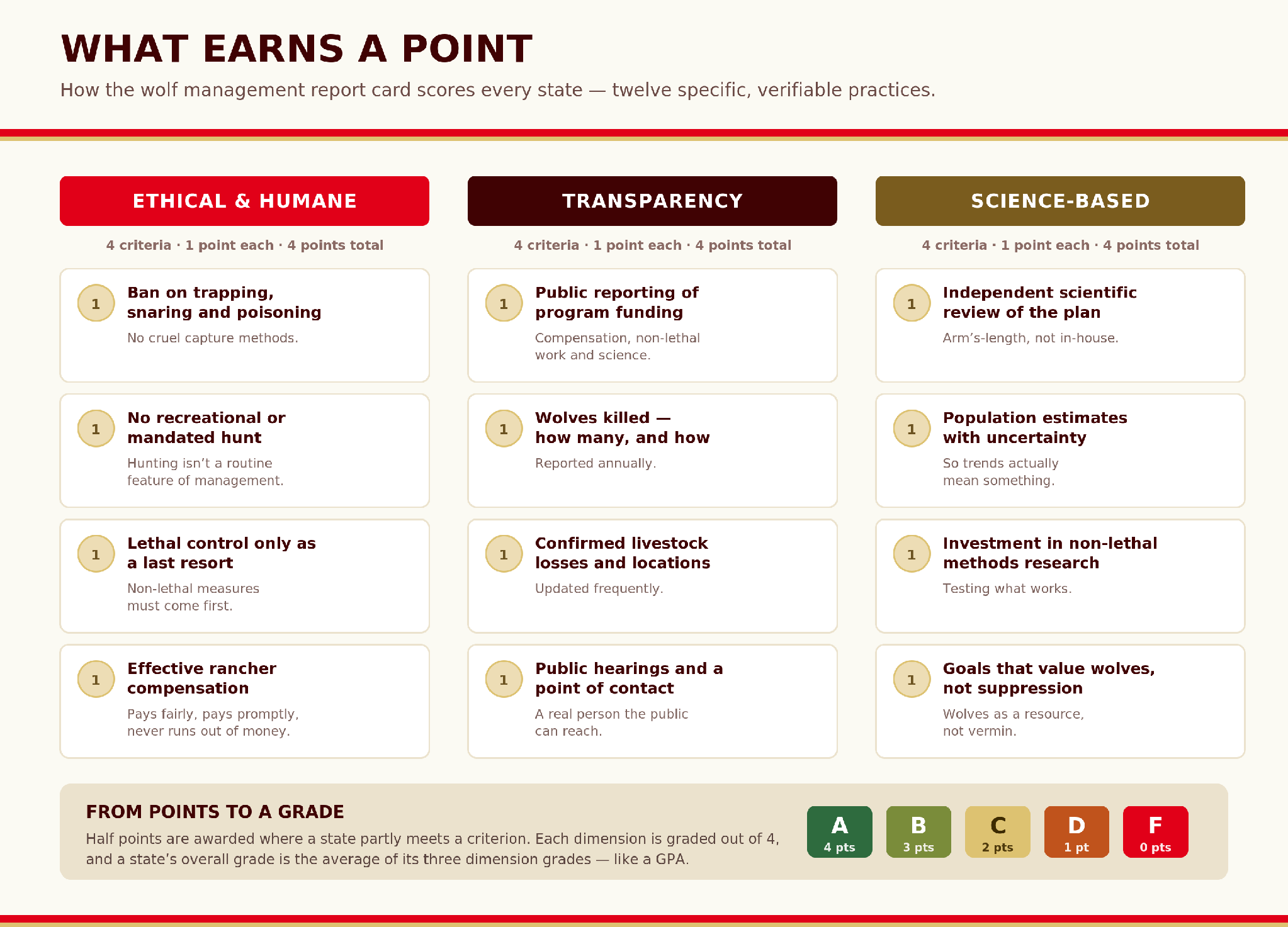
Twelve specific, verifiable practices — four in each dimension.
Most elements in the report card are self-explanatory. For example, the bare minimum for transparency is the holding of open town hall meetings for input, as well as a contact person from whom the public can get information regarding wolf management. In addition, if ranchers and wolf advocates are to come to some sort of compromise, they need to be discussing the same data regarding the key features of the wildlife-livestock conflict. Thus, in addition to town hall meetings, there should be easily accessed public disclosure of (i) confirmed livestock kills by wolves, (ii) the number of wolves killed and how, and (iii) budgetary allocations for wolf management, rancher compensation, and monitoring and evaluation.
For science, the definition of “good” is not as straightforward. For that reason, Team Wolf focuses on features of science that can be easily assessed. I think everyone would identify regular estimates of wolf populations with uncertainty bounds to be essential for science-based management of wolves. In addition, independent science peer review is widely recognized as the standard for quality science in any arena. The last two ingredients key to the science of wolf management are subtler and unique to wolves. First, the goals for wolf population management should acknowledge the ecological and social value of wolves and avoid assuming suppression is the goal without data to support that suppression is justified. Lastly, given recurring episodes of livestock depredation there is a clear need for research into nonlethal methods. States that are not investing in research surrounding nonlethal control have little hope of achieving a positive future for both wolves and ranchers.
Finally, we realize that ethics and humane treatment of animals is a matter of individual values and personal moral code. Thus, while I could never kill a wolf — I find it unfair to ranchers to insist on an absolute ban on lethal control. I understand that a problem pack such as California’s Beyem Seyo pack needs to be addressed. However, there are three control measures that Team Wolf feels strongly are inhumane: any trapping or snaring of wolves, lethal control except as a last resort, and recreational or mandated wolf hunts each year. In addition, if all this care is being taken for wolves, there needs to be re-assurances given to ranchers who may lose livestock. Ethically, this means ranchers should be able to count on being fairly compensated for those instances where wolves do take their livestock.
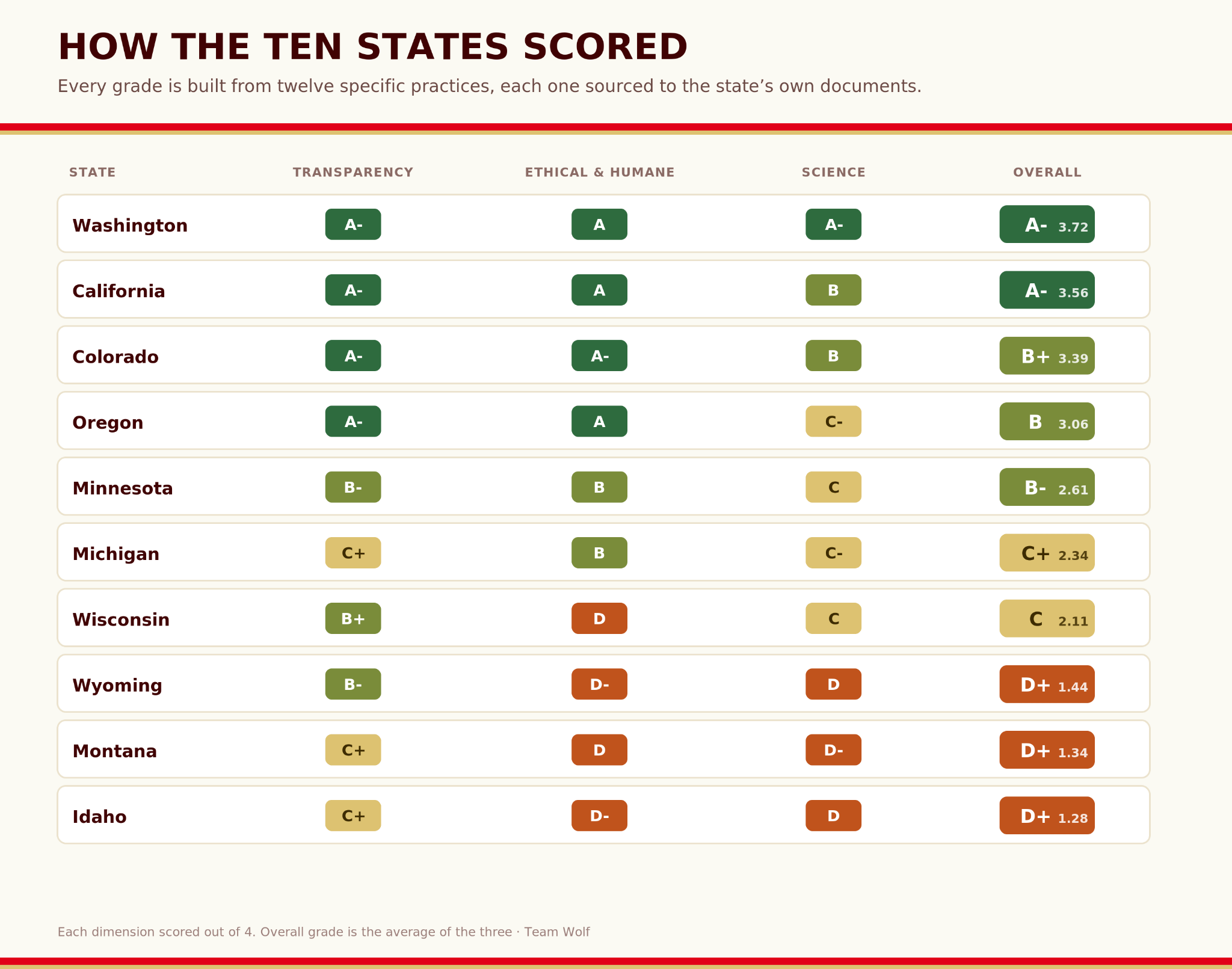
Check out how each state scored on its wolf management policies on our interactive map HERE.
Why this matters now
Recent analyses show that previous de-listing decisions for wolves have often resulted in increased mortality and reduced population recovery. This is not the situation everywhere — but it is the situation in several states. As wolves leave the protection of the federal government, it is increasingly important to hold states accountable for their treatment of wolves. Our wolf management report card does just that.
Every state’s full report card including its wolf population, its score on all twelve criteria, and the source behind each one is on our interactive map.
Where states most often fail in their report card is in the “Ethical and Humane” column above – with 4 of 10 states “earning” a D grade. Each year, The Animal Legal Defense Fund (ALDF) ranks all 50 US States with respect to statewide protections for animal welfare in general (not with respect to wolves). Perhaps not surprisingly, the four states receiving D’s for “ethical and humane treatment” of wolves, all score in the lower half of ALDF’s rankings, with Idaho near the very bottom at 48 in the 2025 assessment. Although the importance one gives to animal rights might be viewed as a personal value, it is a value strongly influenced by recent scientific discoveries. In the next post, “Grief, pain and sentience in the animal world,” I will share how public commitment to animal welfare has been altered by what we are learning about the inner lives and feelings of animals.
Meanwhile, with President Trump’s Executive Order instructing the Department of Interior to remove ESA protections for wolves (find my thoughts about that here), it becomes all that much more important to hold states accountable – as it is states that will likely determine the fate of wolves.
See you next time.
Best,
Peter & the Wolves